The INSPIRA Philosophy – A conscious development approach
The Industrial Revolution has had a profound impact on people’s daily lives, both positive and negative. Its adverse consequences (new building materials vs. pollution, new jobs vs. inequality) have, over the past century, inspired architects, natural philosophers, politicians and many others to search for a new equilibrium.
Architects such as Frank Lloyd Wright, Richard Neutra and Rudolf Steiner have explored different ways of restoring the relationship between nature and the built environment through their work. They helped lay the foundations for a more holistic approach to architecture and the built environment, influenced in part by natural philosophers and thinkers such as Johann Wolfgang von Goethe, Ralph Waldo Emerson, John Muir and Henry David Thoreau.
Within this holistic approach, people are placed at the centre, while nature serves as a source of inspiration for design and architecture.
Climate change, the energy crisis and increasing scientific evidence have raised awareness of the profound impact of the built environment. These growing impacts and the visible consequences for both people and nature, underline the need for a fundamental transformation in the way we design, develop and construct our built environment.
For too long, the built environment industry has focused predominantly on the short term and is now being confronted with the long term consequences of that approach. This reality highlights the need to fundamentally rethink the entire development and construction process in order to create a new balance between buildings, people and nature.
INSPIRA believes this balance should be regenerative: creating a positive impact on people while remaining in harmony with nature, with the objective of restoring, creating and preserving healthy ecosystems.
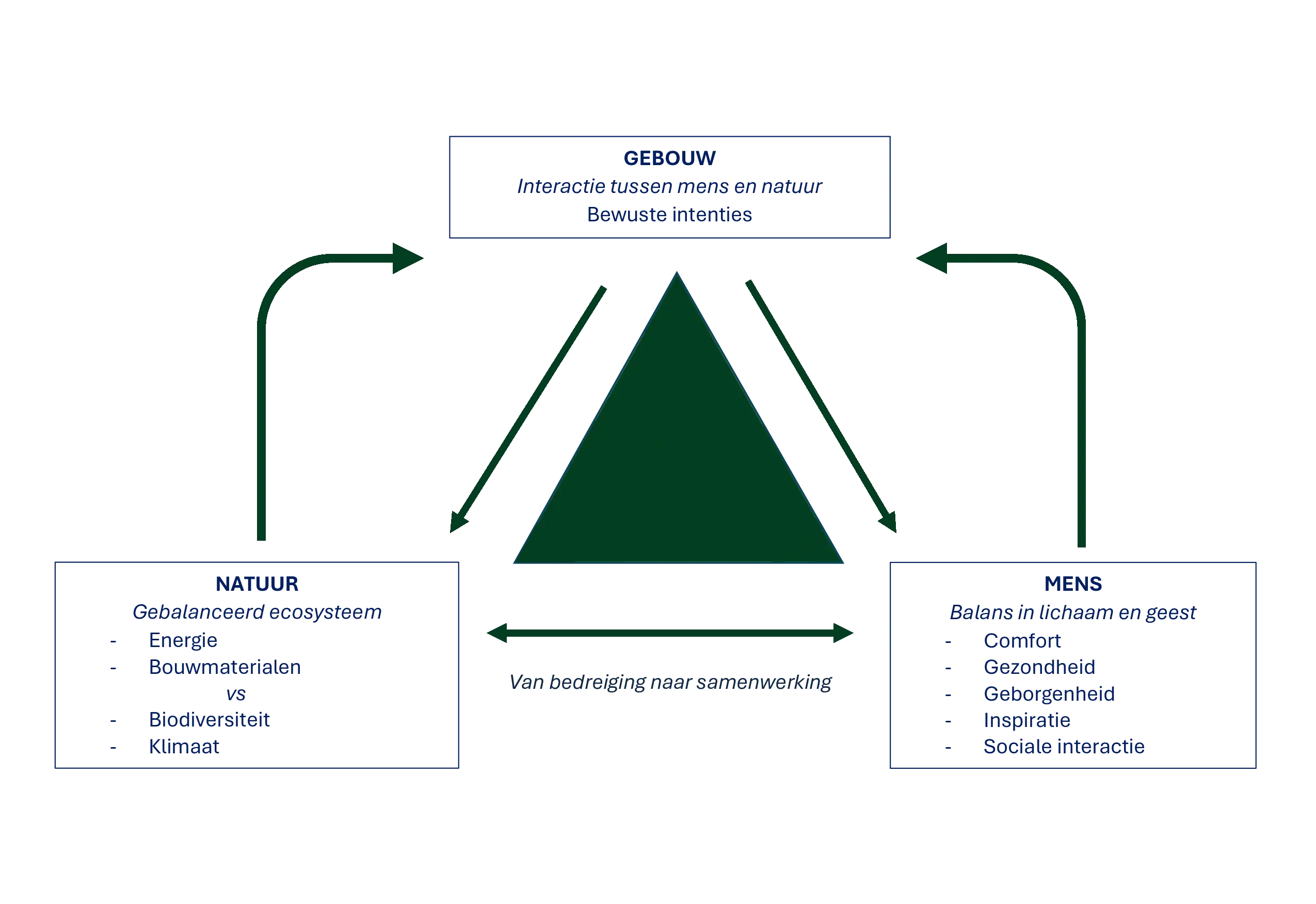
INSPIRA has translated this philosophy into a set of concrete principles that guide the development and delivery of buildings (see framework). For a more detailed explanation of the INSPIRA philosophy, please refer to the INSPIRA white paper: A Vision for Buildings, People and Nature.
Development approach INSPIRA
Building
Every building is shaped by a range of intentions. To create a positive impact, these intentions need to be consciously defined and directed. INSPIRA works across three levels of influence, each with its own sphere of impact, with the ultimate objective of creating a positive effect on both people and nature.
The first level concerns the intentions behind the building itself and the interests that arise from them. These intentions form the foundation for all key decisions relating to the building and therefore represent the most important level for creating meaningful impact.
The second level of influence results from the choices made in the design and materialisation of the building. The conscious selection and application of materials requires an in-depth understanding of architecture, construction and the materials used to shape the built environment.
The third level of influence lies in the construction process itself. The way in which a building is made can ultimately affect the people who will use it. Key considerations include the chosen construction methodology, the people responsible for managing the production of the building components, and the people who physically construct and assemble the building.
INSPIRA consciously works across all three levels in the development and delivery of its projects, based on the conviction that a genuinely positive impact can only be achieved when attention is given to each of these dimensions.
People
Architecture designed around people should contribute to both physical and mental wellbeing and support positive energy levels.
INSPIRA’s ambition is to contribute to people’s physical and mental wellbeing and to create environments that support positive energy, vitality and quality of life. Across its projects, INSPIRA seeks to incorporate five essential qualities into the built environment:
Nature
The climate is changing. While the precise nature and extent of future changes cannot be predicted with certainty, clear trends and impacts are already visible. People will need to adapt to these changes in order to maintain a healthy and liveable environment.
Nature provides an important source of inspiration in this respect. For millions of years, natural systems have continuously adapted to changing conditions on Earth. From ice ages to periods of extreme heat, nature has evolved highly effective and efficient ways of responding to change.
Nature can therefore be viewed as an extensive library of ideas, strategies and solutions for many of the challenges currently facing the built environment, including flooding, heat stress, drought and land subsidence. Biomimicry can play an important role in creating more climate-adaptive buildings and environments — meaning buildings and places that respond effectively and proactively to current and anticipated climatic conditions — while also supporting more circular approaches to energy and material use.
In addition to climate-adaptive design and construction, there is also an important responsibility to give back to nature and to work more closely with natural systems. This can be achieved through nature-inclusive design and construction.
Nature-inclusive development means deliberately creating space for biodiversity in, on and around buildings and within the wider built environment, thereby providing habitats for a greater diversity of plant and animal species.
Climate-adaptive and nature-inclusive design and construction are fundamental principles across all INSPIRA projects. Through this approach, INSPIRA aims to become part of the solution by working with nature rather than against it.
